

Market Commentary - October 2026

While September lived up to its reputation as a difficult month for investors, the real story wasn't the modest decline in stocks but the bond market's message. We'll explore how higher interest rates are reshaping markets around the world and why strong corporate earnings may ultimately prove more important than rising yields in determining where stocks go next.
| Index | September 2026 (%) | YTD (%) | 1-Year (%) | 3-Year Annualized (%) |
| S&P 500 Index | (0.4) | 12.7 | 15.7 | 22.8 |
| Dow Jones Industrial Average | (4.1) | 7.2 | 11.5 | 17.0 |
| NASDAQ Composite Index | 1.9 | 16.1 | 19.3 | 27.5 |
| Russell 2000 Index | (5.3) | 13.9 | 16.4 | 17.7 |
| MSCI All Country World Index (ex U.S.) | (2.4) | 14.7 | 20.5 | 21.2 |
| MSCI Emerging Markets Index | (0.7) | 23.5 | 29.5 | 24.6 |
| U.S. Aggregate Bond Index | (2.6) | (2.9) | (1.8) | 4.1 |
September Lived Up to Its Reputation
September has historically been the weakest month of the year for stocks, making it a familiar source of investor anxiety. This year, however, the seasonal weakness served primarily as a backdrop for a more important shift in market leadership and investor sentiment.
Despite only a modest decline in the broader market, the underlying action was far less encouraging. Market leadership narrowed significantly as Technology was the only S&P 500 sector to post a positive return, advancing 5.0% as investors continued to favor companies tied to artificial intelligence, digital infrastructure, and productivity-enhancing technologies. The remaining ten sectors finished lower, with Materials, Financials, Real Estate, Utilities, Consumer Discretionary, and Industrials posting the steepest declines. Small-cap stocks also came under pressure, suggesting investors were becoming increasingly selective and less willing to embrace economically sensitive areas of the market. International developed markets and emerging markets likewise moved lower, reflecting a more cautious global risk environment.
By month-end, investors found themselves weighing two increasingly different views of the economy. Equity investors remained encouraged by healthy earnings growth, continued AI-related investment, and a still-resilient economy. Yet beneath the surface, market participation was narrowing, defensive positioning was increasing, and investors were showing a growing preference for companies capable of delivering earnings growth regardless of the economic backdrop. That divergence set the stage for the market's most important story and the question that increasingly dominated investor attention as the quarter came to a close.
The Bond Market is Screaming. The Question is What It’s Saying.
While investors spent much of 2026 focused on artificial intelligence, earnings growth, and Federal Reserve policy, the most important story in financial markets may have been unfolding in plain sight. September delivered the Bloomberg U.S. Aggregate Bond Index's worst monthly decline since September 2022, while yields on 2-year, 10-year, and 30-year Treasury securities climbed to their highest levels in roughly two decades. The 10-year Treasury yield moved above 5.2%, the 30-year Treasury approached 5.6%, and investors suddenly found themselves confronting an unfamiliar reality: the era of exceptionally cheap money appears to be firmly behind us.
The End of Cheap Money
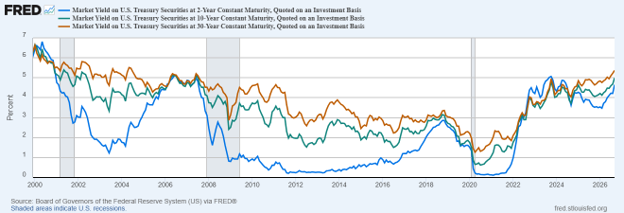
Predictably, the forecast industry has responded with extremes. Some equity strategists argue that higher interest rates will trigger a significant stock market decline as valuations adjust to a higher cost of capital. Meanwhile, some bond bears believe rising yields are only in the early stages of a longer-term move higher, driven by persistent fiscal deficits, expanding Treasury issuance, elevated inflation, and an economy that has proven far more resilient than expected. Editors at Bloomberg Opinion recently warned that rising interest costs could create a dangerous feedback loop in which larger deficits require more borrowing, putting further upward pressure on interest rates.
Yet markets rarely move on a single narrative, and today's environment is more nuanced than either camp admits. Rising yields are not necessarily signaling recession. In fact, many factors driving rates higher reflect economic strength. AI-related capital expenditures, resilient corporate earnings, healthy labor markets, and stronger-than-expected economic growth have all contributed to higher estimates of the economy's long-term growth potential. Strategists at Fidelity Investments describe the current environment less as a crisis and more as a repricing of the appropriate cost of capital after more than a decade of extraordinary monetary accommodation.
The bond market is increasingly focused on structural forces. Governments around the world are running large deficits. Corporations are issuing debt to fund massive investments in data centers, power infrastructure, and artificial intelligence. Foreign demand for U.S. Treasuries is no longer as dependable as it once was, particularly as countries such as Japan normalize interest-rate policy. The result is a higher term premium, the additional compensation investors demand to lend money for longer periods. Put simply, investors are requiring higher returns before committing capital.
For equity investors, the challenge may not be economic weakness but competition. For much of the last decade, investors had little alternative to stocks. Today, investors can earn yields above 5% from U.S. Treasury securities and more than 6% in certain investment-grade fixed-income sectors. That does not mean stocks are doomed. Earnings growth remains healthy, productivity gains from AI could prove substantial, and economic momentum remains intact. It does mean, however, that the valuation tailwind created by falling interest rates has become a headwind. The question facing investors is no longer whether higher rates matter. The question is whether markets can successfully transition to a world where both stocks and bonds once again have to compete for every investment dollar.
A Global Cost of Capital Reset
The end of easy money is not simply a Federal Reserve story. As the accompanying chart shows, the United States, United Kingdom, Euro area, and Japan spent much of the period following the Global Financial Crisis with exceptionally low, and in some cases negative, policy rates. That synchronized support helped lower borrowing costs and lift asset valuations around the world. Today, policy settings are materially higher, but the paths ahead are diverging. At the end of September, the Federal Reserve’s target range stood at 3.75% to 4.00%, the Bank of England’s policy rate at 3.75%, and the European Central Bank’s deposit rate at 2.50%. Japan is also moving away from the near-zero-rate policies that distinguished it from other major economies for decades.
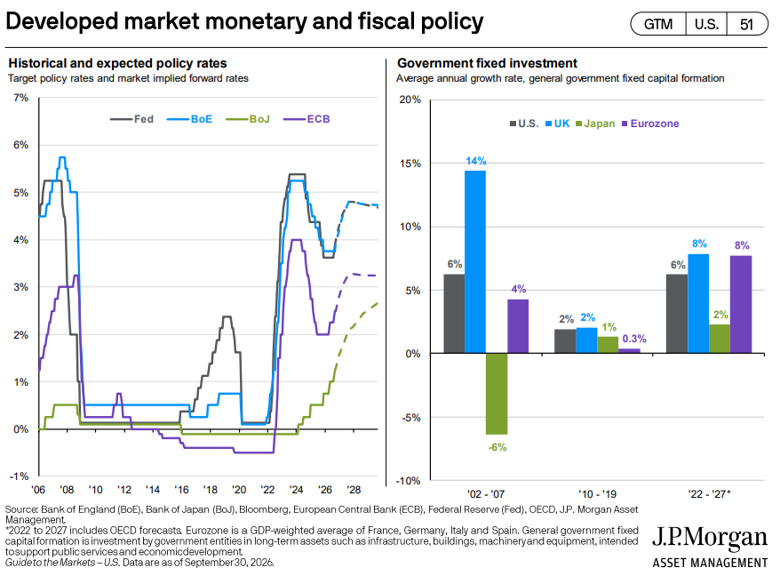
That divergence matters because interest-rate differences affect currencies, capital flows, hedging costs, and the relative appeal of global assets. Japan is especially important. Years of extremely low domestic rates encouraged Japanese investors to seek higher returns overseas, supporting demand for U.S. and European securities. As Japanese rates normalize, more capital has an incentive to remain at home. At the same time, governments and corporations are competing more aggressively for a finite pool of savings to finance defense, infrastructure, energy security, data centers, and artificial intelligence. A recent note from Fidelity’s Asset Allocation Research team identifies Japan’s normalization, changing foreign demand, and heavier public- and private-sector borrowing as key forces behind the global bond-market adjustment.
The consequences are beginning to extend beyond government bond yields. Allianz Chief Economic Advisor Mohamed El-Erian argues that interest-rate risk is increasingly spilling into credit and spread risk, forcing markets to distinguish more carefully among countries and companies. For investors, the message is straightforward: when money is no longer cheap, financial strength matters more. Durable cash flow, manageable debt, limited refinancing needs, and valuation discipline should become increasingly important, while familiar labels such as “developed” and “emerging” may reveal less about risk than the underlying quality and credibility of the borrower.
Looking Ahead
For much of the past month, investors have been focused on interest rates, bond yields, and the cost of capital. As we move into the heart of October, however, the market's attention is likely to shift back to a more familiar driver of long-term stock prices: corporate earnings. Encouragingly, the early setup for third-quarter earnings season remains considerably stronger than historical norms. According to FactSet Research, analysts currently expect S&P 500 earnings to grow 29.5% year-over-year, which would mark the third consecutive quarter of earnings growth above 25% and the eighth consecutive quarter of double-digit earnings growth. Revenue growth is projected at 12.3%, while all eleven sectors are expected to report positive year-over-year earnings growth.
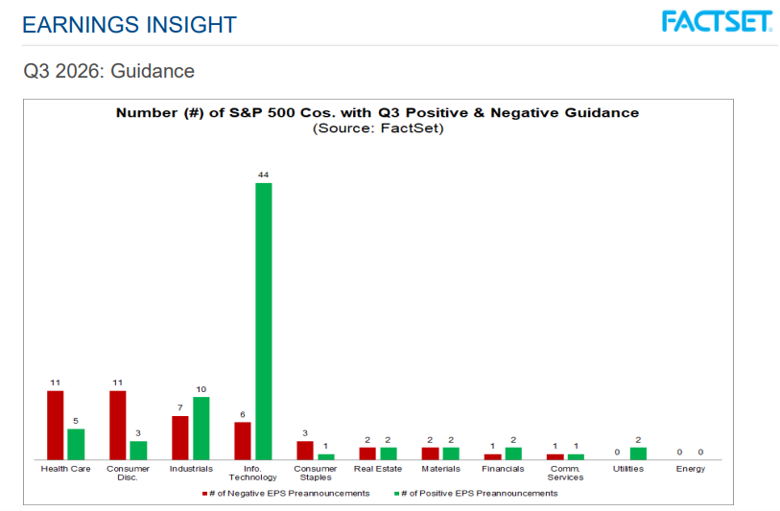
Perhaps even more noteworthy is the direction of earnings revisions. Analysts typically lower estimates as a quarter progresses, with the average reduction over the past ten years totaling 2.5%. This quarter, estimates moved in the opposite direction. Bottom-up earnings expectations increased 1.4% between June 30 and September 30, making Q3 the second consecutive quarter in which analysts raised forecasts during the quarter itself. At the same time, companies have issued an unusually optimistic outlook. A record 72 S&P 500 companies have issued positive EPS guidance, compared to just 44 negative preannouncements, the highest number of positive guidance revisions since FactSet began tracking the data in 2006. Technology companies account for much of that optimism, but strength is not confined to a single industry.
The improving earnings picture arrives alongside several encouraging developments on the economic front. Inflation pressures have eased modestly in recent weeks, labor-market data suggest slower but still positive job creation, and supply concerns in energy markets have begun to moderate. According to Mohamed El-Erian, crude oil shipments moving through the Strait of Hormuz have recovered to more than 90% of pre-conflict levels, while coordinated discussions among G-7 countries regarding strategic inventory releases have helped reduce concerns about severe supply disruptions heading into the Northern Hemisphere winter. Combined with signs of stabilization in European and Chinese purchasing manager surveys, these developments suggest that fears of an immediate economic slowdown may be overstated.
Valuations also appear somewhat more reasonable than they did earlier this year. The forward 12-month P/E ratio for the S&P 500 currently stands at 19.0, below both its five-year average of 19.8 and its ten-year average of 19.1. At the same time, analysts continue to project earnings growth of 27.6% in the fourth quarter and 32.4% for full-year 2026. In other words, while higher interest rates have unquestionably become a headwind, corporate America continues to deliver the type of earnings growth that historically supports higher stock prices over time.
Against that backdrop, the coming earnings season may provide investors with an important reminder. Markets ultimately follow profits. Interest rates influence valuations, but earnings determine intrinsic value. After a quarter dominated by discussions of bond yields, deficits, and central-bank policy, the next several weeks may reveal whether corporate America can continue to grow fast enough to justify the market's resilience. Thus far, the early evidence suggests the answer remains yes.
As always, we remain focused on your long-term investment plan rather than making large shifts based on short-term market movements. That said, today's environment presents opportunities to make thoughtful adjustments around the edges of portfolios, including adding high-quality fixed income where higher yields offer attractive income and rebalancing when volatility creates opportunities. At the same time, strong corporate earnings, rising earnings estimates, and record levels of positive earnings guidance continue to support long-term equity exposure, particularly among companies with durable cash flows, strong balance sheets, and sustainable competitive advantages. In our view, patience and discipline remain the best course, while selectively taking advantage of opportunities created by higher yields and periodic market dislocations.
Thank you for your continued confidence in our team, and please reach out with any questions you may have. It is our pleasure to share life’s journey with you.
Market Commentary Disclosures
*Magnificent Seven: The term "Magnificent Seven" was coined by others and should not be construed as an endorsement or indicator of any stock or company's quality.
This document is a general communication being provided for informational purposes only. It is educational in nature and not designed to be taken as advice or a recommendation for any specific investment product, strategy, plan feature or other purpose in any jurisdiction, nor is it a commitment from Towne Trust to participate in any of the transactions mentioned herein. Any examples used are generic, hypothetical and for illustration purposes only. This material does not contain sufficient information to support an investment decision and it should not be relied upon by you in evaluating the merits of investing in any securities or products. In addition, users should make an independent assessment of the legal, regulatory, tax, credit, and accounting implications and determine, together with their own financial professional, if any investment mentioned herein is believed to be appropriate to their personal goals. Investors should ensure that they obtain all available relevant information before making any investment. Any forecasts, figures, opinions or investment techniques and strategies set out are for information purposes only, based on certain assumptions and current market conditions as of the date given and are subject to change without prior notice. All information presented herein is considered to be accurate at the time of production, but no warranty of accuracy is given and no liability in respect of any error or omission is accepted. It should be noted that investment involves risks, the value of investments and the income from them may fluctuate in accordance with market conditions and taxation agreements and investors may not get back the full amount invested. Neither past performance or yields are reliable indicators of current and future results.
Stock investments involve risk, including loss of principal. High-quality stocks may be appropriate for some investment strategies. Ensure that your investment objectives, time horizon and risk tolerance are aligned with investing in stocks, as they can lose value. Although we define “high quality” stocks as having high and stable profitability (return on equity, earnings variability) the term “high quality” is not a recommendation for any specific investment as stocks may not be appropriate for some investment strategies.
There are risks associated with fixed-income investments, including credit risk, interest rate risk, and prepayment and extension risk. In general, bond prices rise when interest rates fall and vice versa. This effect is usually more pronounced for longer term securities. A rise in interest rates may result in a price decline of fixed-income instruments held by the fund, negatively impacting its performance and NAV. Falling rates may result in the fund investing in lower yielding debt instruments, lowering the fund’s income and yield. These risks may be heightened for longer maturity and duration securities.
Towne Trust, its affiliates and/or their respective officers, directors or employees may from time to time acquire, hold or sell securities mentioned herein.
Index Definitions
Dow Jones Industrial Average: The Dow Jones Industrial Average is a price-weighted average of the 30 blue chip stocks that are generally the leaders in their industry. It has been widely followed indicator of the stock market since October 1, 1928.
NASDAQ Composite Index: The NASDAQ Composite Index is a broad-based capitalization-weighted index of stocks in all three NASDAQ tiers: Global Select, Global Market and Capital Market. The index was developed with a base level of 100 as of February 5, 1971.
Russell 2000 Index: The Russell 100 Index is comprised of the smallest 2,000 companies in the Russell 1000 Index, representing approximately 8% of the Russell 3000 total market capitalization. The real-time value is calculated with a base value of 135.00 as of December 31, 1986. The end-of-day value is calculated with a base value of 100.00 as of December 19,1978.
S&P 500 Index: The S&P 500 Index is widely regarded as the best single gauge of large-cap U.S. equities and serves as the foundation for a wide range of investment products. The index includes 500 leading companies and captures approximately 80% coverage of the available market capitalization.
MSCI Emerging Markets Index: The MSCI EM (Emerging Markets) Index is a free-float weighted equity index that captures large and mid-cap representation across Emerging Markets (EM) countries. The index covers approximately 85% of the free float-adjusted market capitalization in the each country.
U.S. Aggregate: The Bloomberg USAgg Index is a broad-based flagship benchmark that measures the investment grade, US dollar-denominated, fixed-rate taxable bond market. The index includes Treasuries, government-related and corporate securities, MBS (Agency fixed-rate pass-through), ABS and CMBS (agency and non-agency). (Future Ticker: I00001US)
MSCI ACWI Excluding United States Index: The MSCI AC World ex USA Index is a free-float weighted equity index. It was developed with a base value of 100 as of December 31, 1987.